Harden Family Farms: Agriculture in Maryland’s Piedmont Region
A History Rooted in the Piedmont Plateau of Carroll County, Maryland
Nestled between the eastern coastal plains and the Blue Ridge Mountains to the west, the Piedmont Plateau of Carroll County is an ancient land. When Maryland was founded in the early 1600s, this region was already a crossroads for the Susquehannock, Lenape, Algonquian, and Iroquois nations, whose trails – such as the Patapsco-Conewago (Hanover) Road – linked the Susquehanna to the Potomac. Long before colonial settlement, people traveled through this landscape for trade, ceremony, and sustenance. The streams that cut through the rolling hills carried stories from one watershed to another. The soil itself – rich, red, and full of iron and quartz – bears witness to millennia of human and natural activity.
Early Settlement and Continual Cultivation
When the first European settlers arrived in the 1700s, drawn by the promise of fertile ground and a temperate climate, they cleared forests of oak, poplar, and hickory to establish small homesteads. They planted wheat, rye, corn, and flax, raised cattle and hogs, and built stone barns and springhouses that still dot the countryside today. Our farm, though it has changed hands among several families, remains part of that unbroken lineage of working the land. Its fencerows, hedgerows, and old wagon ruts speak of centuries of cultivation and care.
Soil, Topography, and Watersheds
The landscape itself defines our farm. Carroll County sits in the heart of the Piedmont—a transitional zone between the low coastal plains of the Chesapeake and the high Appalachian ridges beyond. It is a landscape of gentle slopes, well-drained loams, and shallow valleys carved by the tributaries of the Patapsco River. Our soils—predominantly Manor, Glenelg, and Chester silt loams—are considered prime farmland by the USDA. They hold moisture well, yet drain efficiently, allowing for deep root growth and diverse plantings. In every handful of earth, one can find the mineral fingerprints of ancient metamorphic rock—gneiss, schist, and quartzite—that weathered over hundreds of millions of years.
Farming Infrastructure & Heritage
The farm’s 19th-century barn, restored by hand and now glowing again with life, stands on land that was once part of a larger agricultural parcel worked by draft horses and mule-drawn plows. The foundations are set on stone gathered from the very fields it shelters. The barn overlooks a south-facing slope, ideal for growing vegetables, herbs, and flowers in the long Maryland growing season. The air carries the scent of hay and clover in the summer, and in the fall, the sound of crickets fades into the quiet rustle of drying corn stalks.
Stewardship Through Organic & Regenerative Practices
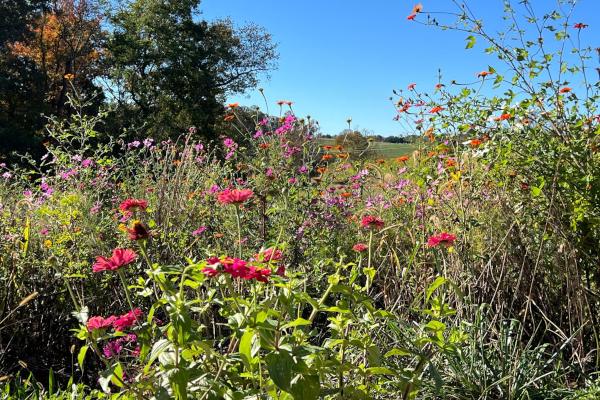
We are stewards of this land, not just owners. Our organic and regenerative practices are our way of honoring what came before. The soil is amended only with mushroom compost, biochar, and organic matter from our own farm – leaves, manure, and crop residues that build fertility rather than deplete it. Our high tunnels extend the season, allowing early spring greens and late-fall tomatoes to thrive without chemicals or synthetic fertilizers. We plant native pollinator strips to support bees and butterflies, and rotate crops to preserve soil health. Even our livestock – laying hens, Babydoll sheep, and goats – play their part in the ecology, grazing and fertilizing as nature intended.
Watershed Responsibility & Chesapeake Bay Connection
The farm sits on a subtle watershed divide. Rain that falls on one side of the ridge trickles down toward the Patapsco, while on the other it flows into tributaries of the Monocacy River. Both rivers eventually meet the Chesapeake Bay, meaning our work here – how we treat our soil and water – ripples outward into one of the nation’s most vital ecosystems. Every choice we make, from planting cover crops to managing erosion, is connected to a larger web of environmental responsibility.
Seasonal Rhythm: March through Winter
Seasons on the land define the rhythm of life. In March, the first crocuses and overwintered spinach break through the thawing ground. April brings the hum of bees among fruit blossoms, and by June, the high tunnels are bursting with tomatoes, peppers, and basil. Summer is long and humid, the soil warm and forgiving. Fall is a time of abundance – zinnias and dahlias in bloom, squash curing in the barn, apples simmering into butter. Winter settles quietly, with frost tracing the fences and the smell of wood smoke drifting from the farmhouse. Each season leaves its mark, reminding us that the land is never static – it rests, breathes, and renews.
The Land’s Resilience & the Future of Farming in the Piedmont
The character of the Piedmont land is also shaped by its resilience. The region has seen tobacco replaced by grain, dairy, and now diversified small farms. Where industrial agriculture once dominated, a new generation of farmers is rediscovering the value of smaller, sustainable production. Our farm is part of that movement – growing not only food but community, inviting neighbors, market customers, and visitors to reconnect with where their nourishment begins.
Observing Nature Amid Cultivation
Walking the property, one can still see the contours of old field divisions – low stone walls, hedgerows of multiflora rose, and mature black walnut trees marking former boundaries. In spring, a chorus of tree frogs rises from the small pond that collects runoff from the upper field. Deer and wild turkey pass through at dawn. Red-tailed hawks nest in the oaks that line the western edge, and monarch butterflies find milkweed along the roadside ditch. This mosaic of cultivated and wild spaces makes the land feel alive in every direction.
Legacy, Promise & Community
At the center of our stewardship is the understanding that land is both inheritance and promise. Each generation receives it in a certain condition and must decide how to leave it for the next. We do not measure our success only by yields or sales, but by the slow accumulation of life in the soil – worms, microbes, fungi, and roots forming a living network beneath our feet. The richer that web becomes, the more resilient the farm will be against drought, disease, and time.
Farming in Carroll County also means being part of a larger community of people bound by the land. The patchwork of small farms, historic towns, and wooded hills creates a sense of place unlike anywhere else. Westminster’s farmers markets, church suppers, and roadside stands all echo the same truth: this region’s identity is still agricultural at its heart. Our farm is just one chapter in that ongoing story.
On some mornings, when mist settles over the lower pasture and the first light catches the barn roof, it’s possible to feel the continuity of centuries. The same rising sun once guided Native travelers along the Conewago Road, settlers with ox carts, and now us – farmers working with tractors powered by biodiesel and solar panels glinting on the barn roof. Technology has changed, but the essence of the work remains: turning sunlight, soil, and water into nourishment.
A Living Classroom & Sanctuary
Our farm’s land is more than a production space – it is a living classroom and sanctuary. We host children who have never pulled a carrot from the ground, families who come to see lambs born in spring, and neighbors who share stories of the land as it once was. Through these moments, the soil becomes a thread connecting past and future.
The Land – Ancient, Ever-New
In this way, the land is both ancient and ever new. It carries fossils of an old mountain range and the footprints of modern farmers. It remembers droughts and floods, harvests and seasons of rest. And it continues to give – quietly, steadily – when tended with respect. At Harden Family Farms, we are merely the current caretakers of a much longer story. Our task is simple but profound: to leave the land richer, cleaner, and more vibrant than we found it, so that those who follow – our children, their children, and the wild things that share this space – will inherit a piece of Maryland’s Piedmont that still breathes with life.